
- EU Battery Regulation 2023/1542
- Industry DPP
Digital Product Passport for Batteries
The EU Battery Regulation mandates Digital Product Passports for EV and industrial batteries from 2027 — chemistry, carbon footprint, state of health, and full supply chain traceability. Get compliant today, directly from Shopify.
2027
EV battery deadline
12+
Years EU compliance
Free
Plan — up to 10 products
5 min
Average setup time
A digital record that travels with every battery cell
Under EU Battery Regulation 2023/1542, every EV, industrial, and portable battery placed on the EU market must carry a Digital Product Passport — a machine-readable data record accessible via QR code from day one of sale.

Every battery unit gets its own GS1 QR code linking to a live, always-current passport — scannable by consumers, recyclers, and regulators.

The DPP must include current SoH data — critical for second-life applications, resale, and recyclers assessing remaining value.

Raw materials, cell chemistry, manufacturing site, and carbon footprint per kWh — declared at the unit level, not just product family.

Recyclers scan to find disassembly guidance, critical raw material locations, and hazardous substance declarations — maximising recovery rates.
Regulation context
This is NOT ESPR. Batteries have their own law.
EU Battery Regulation 2023/1542 is a separate, standalone regulation — with its own DPP schema, timeline, and enforcement structure. It entered into force in August 2023 and applies to all economic operators placing batteries on the EU market.

Fields like SoH, SoC, cycle count, and carbon intensity are specific to Battery Reg — not found in ESPR templates.

EV and industrial battery DPPs are required by February 2027 — a year ahead of most ESPR categories.

A declared carbon footprint per kWh is a unique Battery Reg requirement — calculated to a specific EU methodology.
(EU) 2023/1542
- In force
- Carbon footprint declaration
- EV + industrial DPP + QR
- LMT battery DPP
- Portable battery DPP
PassoNext templates are aligned with the Battery Regulation’s official data attribute list — not generic ESPR fields.
The DPP mandate is already live — and accelerating
Battery Regulation 2023/1542 has been applying since 2024. The DPP and QR code requirement is next — and the clock is running faster than most brands realise.
2027
Battery Regulation 2023/1542 fully in force. Applies to all batteries placed on the EU market — EV, industrial, LMT, and portable.
2027
EV battery manufacturers must declare a calculated carbon footprint per kWh using the EU-mandated methodology.
2028
Full Digital Product Passport and GS1 QR code mandatory for EV batteries, LMT batteries, and industrial batteries above 2 kWh.
2029
Consumer and portable batteries (laptops, phones, power tools) require DPPs. Brands selling on Shopify are directly affected.
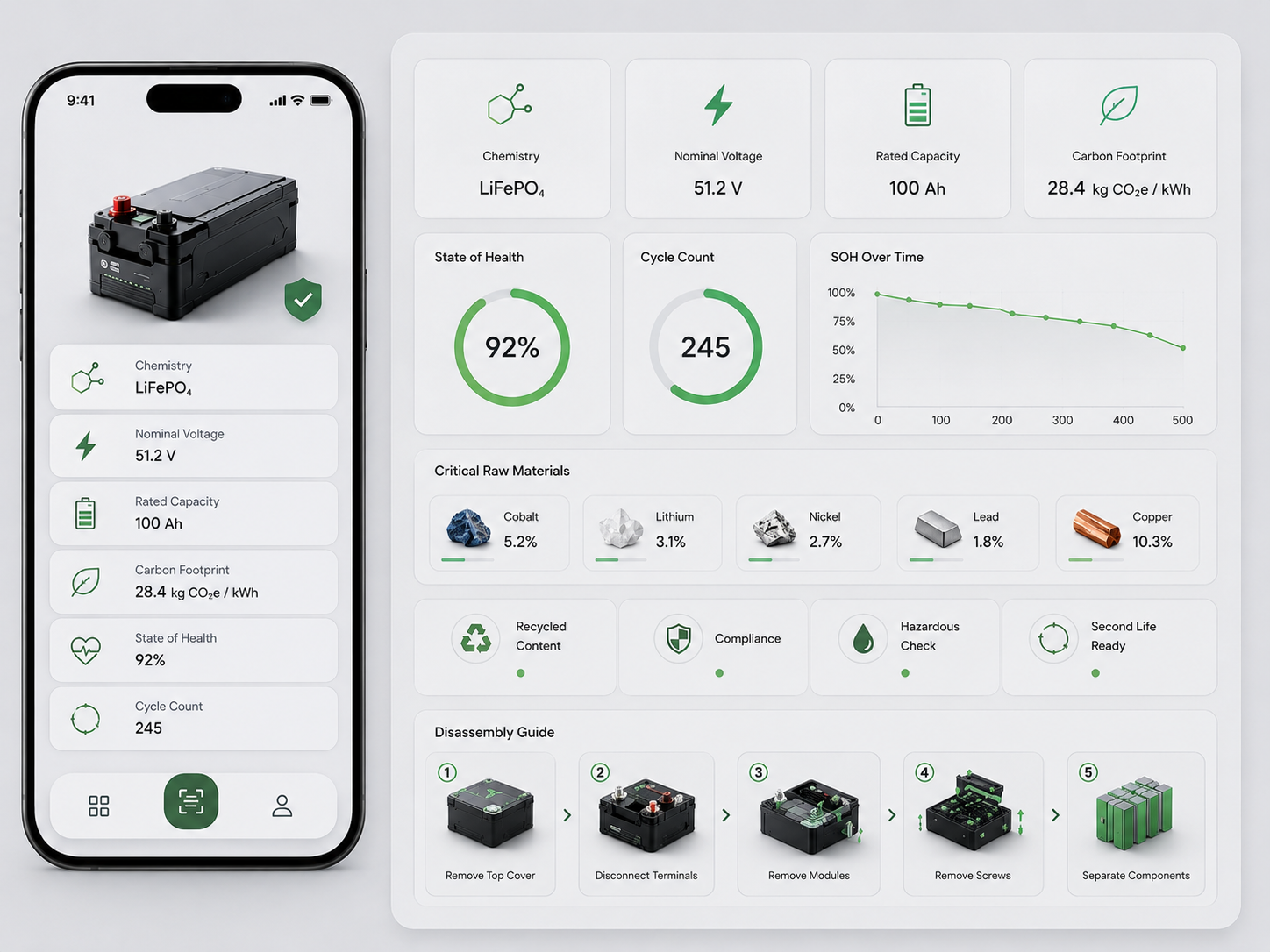
Live passport preview
See a real battery DPP — exactly as an inspector or recycler would.
Every field below is populated automatically from your Shopify product data and stays current as chemistry, state of health, or certifications change.
- Chemistry, nominal voltage, and rated capacity
- Carbon footprint per kWh (EU methodology)
- State of health and cycle count (live from BMS)
- Critical raw materials and hazardous substances
- Recycled cobalt, lithium, nickel, lead content (%)
- Disassembly instructions for second-life routing
Required DPP Data
What your battery DPP must include
Battery Regulation 2023/1542 specifies five mandatory data categories. PassoNext guides you through each with pre-built, schema-compliant fields.

Core battery identity data
- Battery chemistry (NMC, LFP, NCA, etc.)
- Nominal voltage and rated capacity (kWh)
- Expected battery lifetime and cycle count
- Manufacturing date and batch identifier
- Unique battery identifier (serial / GS1)

EU-methodology calculation required
- Carbon footprint per kWh (kg CO₂eq/kWh)
- Carbon footprint performance class (A–E)
- Lifecycle GHG breakdown by stage
- Energy mix at manufacturing site
- Third-party verification status

Critical raw material traceability
- Country of origin for cobalt, lithium, nickel
- Supply chain risk assessment report
- Third-party audit status and link
- Tier 1 and tier 2 supplier declarations
- Conflict mineral compliance status

Substances and recycled content
- Hazardous substances (SVHC list)
- Recycled cobalt content (% by weight)
- Recycled lithium, nickel, lead content
- Electrolyte and separator materials
- Housing and casing material declaration

Recycling and second-life data
- Disassembly instructions for recyclers
- Critical raw material location in pack
- Component recyclability rate (% by weight)
- Take-back and producer responsibility scheme
- WEEE and battery directive compliance

Live data for used & second-life batteries
- Current state of health (% of original capacity)
- Cumulative charge/discharge cycle count
- Current state of charge (SoC)
- Negative events log (deep discharge, overtemp)
- Expected remaining useful life estimate
PassoNext coverage
Every Battery Reg dimension, covered
PassoNext fields map directly to the five compliance dimensions — no gaps, no manual mapping.
General Info
Carbon Footprint
Supply Chain
Materials
End-of-Life
How it works
A compliant battery DPP in 6 steps — from Shopify
No engineers, no compliance consultants, no custom integrations. PassoNext plugs into your existing Shopify setup.
Chemistry, capacity, SoH thresholds, carbon footprint — your product or compliance team likely has most of this from existing test data.
One-click install from the Shopify App Store. Connect your store in under 2 minutes — no code, no developer needed.
Guided fields validate entries against Battery Reg's schema as you type. Templates pre-filled for NMC, LFP, NCA, and Li-Ion chemistries.
A unique, GS1-standard QR code is generated per battery unit or per product model — your choice. Download in print-ready format.
Apply the QR to the battery casing, packaging, or product page. Regulators, consumers, and recyclers can scan immediately.
As SoH changes or certifications update, edit in PassoNext. The QR never changes — the live passport does, automatically.
Who must create the battery DPP?
Under Battery Regulation 2023/1542, the “economic operator” placing the battery on the EU market bears full DPP responsibility — regardless of channel or battery type.

Companies that design and produce the battery cells or pack — whether EV, industrial, or consumer — bear primary DPP responsibility.

Companies bringing batteries from outside the EU must verify DPP compliance before the product enters the EU market or is placed for sale.

Distributors and online retailers — including Shopify sellers — must ensure a valid DPP exists before making batteries available to EU customers.

Non-EU manufacturers can designate an EU-based representative to bear DPP obligations — a common path for Asian battery exporters.

Built by EU compliance specialists
Not a pivot into compliance — this is what we’ve done for over a decade, across ecodesign, REACH, and now the Battery Regulation.

We tracked Battery Regulation 2023/1542 from its first proposal in 2020 through every trilogue revision to final publication.

Our templates use the EU Battery Regulation's own attribute list — not adapted ESPR fields. SoH, SoC, carbon footprint class, and cycle count are all built in.

Listed on the Shopify App Store, reviewed against security, privacy, and data handling standards. Fully GDPR-compliant data processing.

As implementing regulations under Battery Reg are published, PassoNext templates update accordingly — you never have to re-audit your setup.

Every plan includes support from our compliance team — not a bot. Enterprise customers get a dedicated compliance review for their battery DPPs.

Battery DPPs must be available in all EU official languages of markets you sell into. PassoNext handles this automatically from your Shopify market settings.

What happens without a battery DPP?
Once Article 77 of Battery Regulation 2023/1542 applies, the consequences of operating without a valid DPP are severe and immediate.

Batteries without a valid DPP and QR code cannot be placed on or made available in the EU — directly or via Shopify, Amazon, or any channel.

Member states are required to set penalties — several have signalled fines proportional to turnover for repeated violations of Battery Regulation requirements.

Customs authorities will verify DPP QR codes at EU entry points. Batteries entering without a valid passport are subject to seizure and return.

EV manufacturers and industrial buyers are already making DPP-readiness a supplier prerequisite — non-compliant brands get dropped from approved lists.
Get your batteries EU-compliant before the DPP deadline.
Delegated acts under Battery Regulation 2023/1542 are being finalised now. Brands building DPP infrastructure today will be first to market — and first to qualify for B2B supply chains.
- Battery Reg–specific DPP templates
- GS1 QR codes generated per battery unit
- Live updates — no re-labelling needed
- SoH, carbon footprint, and chemistry fields built in
- Syncs directly with Shopify products
- Free plan — up to 10 products
Frequently asked questions
When exactly does the battery DPP requirement kick in?
Under EU Battery Regulation 2023/1542, the Digital Product Passport and QR code requirement applies to EV batteries, LMT batteries (e-bikes, e-scooters), and industrial batteries above 2 kWh from February 18, 2027. Portable batteries (consumer electronics, power tools) follow in February 2028. Implementing regulations are being finalised now, so the practical window to build DPP infrastructure is shorter than it appears.
Is this the same as the ESPR Digital Product Passport?
No — and this distinction matters. Batteries are regulated by EU Battery Regulation 2023/1542, which is a standalone law with its own DPP schema, timeline, and enforcement structure. ESPR covers product categories like washing appliances, textiles, and furniture. Battery-specific fields like State of Health, carbon footprint per kWh, and cycle count are not in the ESPR schema. PassoNext provides dedicated Battery Reg templates for exactly this reason.
What is a "State of Health" declaration, and is it mandatory?
State of Health (SoH) is a percentage representing how much of the battery’s original capacity remains. Under Battery Regulation 2023/1542, SoH must be declared in the DPP for industrial batteries and EV batteries — it’s critical for second-life assessment, resale valuation, and recycler routing decisions. For new batteries, this is typically declared at 100%. For used or refurbished batteries, the actual measured value must be included.
Does the DPP requirement apply to Shopify stores selling EV accessories?
If you sell batteries — or products that contain batteries covered by the regulation — to EU customers through your Shopify store, you are an economic operator under the Battery Regulation. This includes replacement EV battery packs, industrial battery modules, LMT batteries for e-bikes, and portable battery banks. PassoNext connects directly to Shopify so the DPP is generated from your existing product data.
How do I calculate the carbon footprint per kWh?
The Battery Regulation specifies a particular Life Cycle Assessment methodology (aligned with ISO 14040/44 and EU-specific guidance) for calculating carbon footprint per kWh. PassoNext provides a field for entering the calculated value and its performance class (A–E). We recommend working with an LCA specialist or your BMS data team to produce the figure, then recording it directly in PassoNext for passport generation.
How long must the battery DPP remain accessible?
The passport must remain accessible for the entire expected commercial lifetime of the battery, plus at least ten years after the product was placed on the market. For EV batteries with a typical lifespan of 10–15 years, this can mean a hosting obligation extending to 2040 and beyond. PassoNext handles perpetual hosting — the QR code you apply today points to a live, always-accessible passport record.
Make your batteries EU-compliant today.
Start free. No credit card required. Your first 10 battery passports stay free, even after the trial ends.