
EU Digital Product Passport for Batteries 2027: Key Requirements and Compliance Timeline
- Author:PassoNext
- Posted on:

The EU Digital Product Passport for Batteries is moving from preparation to implementation, with a major deadline arriving on February 2027.
From this date, every electric vehicle battery, every light means of transport battery, and every industrial battery above 2 kWh covered by Article 77 must have an electronic Battery Passport when placed on the EU market or put into service.
For Shopify businesses, this is more than another EU compliance requirement. It changes how battery product information needs to be collected, organised, updated, and shared.
A Shopify Digital Product Passport for EV Batteries can help merchants connect their product catalogue with the information needed for a digital battery record.
Why Is the EU Introducing Battery Passports?
Battery supply chains can involve manufacturers, cell suppliers, raw-material providers, recyclers, importers, distributors, and other stakeholders.
Important information about a battery can therefore be spread across different systems.
The EU Battery Passport is intended to create a digital information layer that follows the battery through its lifecycle.
It can make relevant information available to consumers, businesses, repairers, recyclers, authorities, and other authorised stakeholders.
The European Commission identifies information areas including battery identification, technical characteristics, manufacturer information, performance and durability, repair and reuse, recycling, sustainability, and circularity.
The idea is simple:
One battery → one digital identity → relevant information throughout its lifecycle.
What Changes on 18 February 2027?
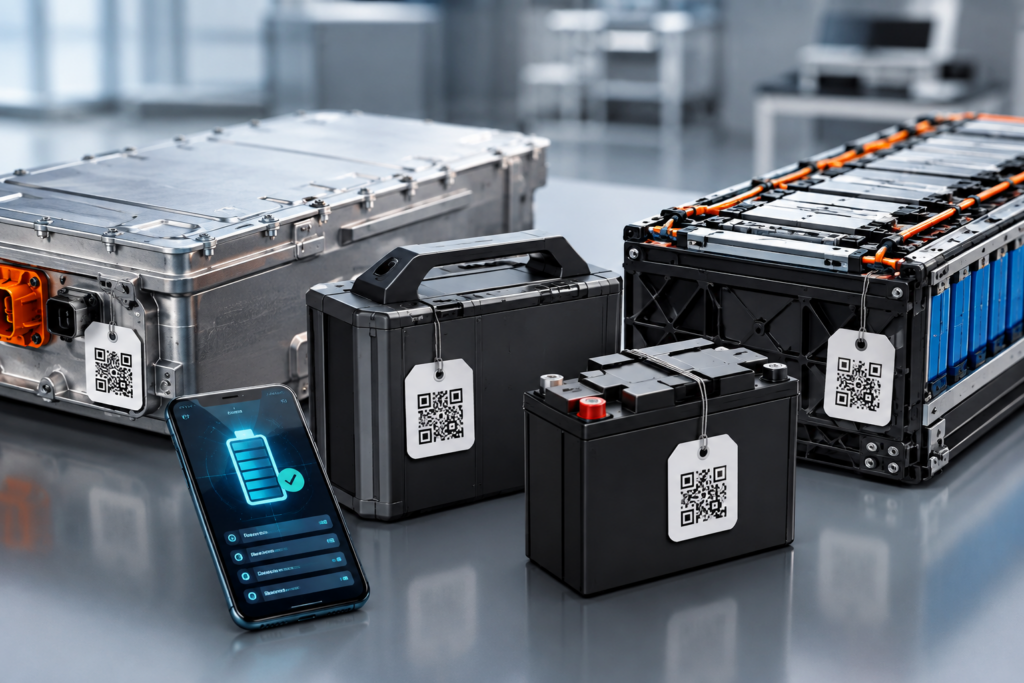
The date to remember is 18 February 2027.
From this date, Article 77 requires an electronic Battery Passport for each in-scope:
- Electric vehicle battery
- LMT battery
- Industrial battery above 2 kWh
The regulation also requires batteries to carry a QR code from the same date. For EV, LMT, and qualifying industrial batteries, that QR code provides access to the Battery Passport. The QR code must be visible, legible, and indelibly marked on the battery.
This means businesses need both sides of the system ready:
Physical battery marking + Digital Battery Passport
A QR code alone is not compliance. It needs to connect to accurate and up-to-date passport information.
What Information Goes Into a Battery Passport?
The exact data depends on the battery category and applicable requirements.
The European Commission’s latest 2026 guidance provides a structured overview of data points for EV batteries, LMT batteries, and industrial batteries above 2 kWh, including whether particular information is mandatory, optional, or conditional for February 2027.
Broadly, Shopify battery sellers should prepare information covering:
Battery Identity
The passport needs to identify the relevant battery and connect the digital record to the correct product.
For Shopify brands, this makes SKU, model, product, variant, and other product identifiers important.
Technical Information
Technical characteristics help stakeholders understand what the battery is and how it is configured.
This information should be mapped to the correct battery model rather than copied across products without verification.
Performance and Durability
Battery performance and durability information can help users and authorised stakeholders understand how the battery performs during its lifecycle.
For EV batteries, this becomes particularly important when batteries are repaired, reused, repurposed, or assessed for further use.
Sustainability and Circularity
The Battery Passport also supports the EU’s circular-economy goals.
Depending on the applicable requirements, information can relate to:
- Carbon footprint
- Recycled content
- Materials
- Resource efficiency
- Circularity
- Reuse
- Recycling
Repair and End-of-Life Information
Relevant stakeholders may need information to repair, dismantle, reuse, repurpose, or recycle batteries.
This is why the Battery Passport is not simply another customer-facing product page. Different users can have different access rights to the information.
Which Businesses Should Prepare?
The obligation is connected to the economic operator placing the finished battery on the EU market.
This is important for Shopify merchants.
A company selling batteries through Shopify should determine whether it is acting as a manufacturer, importer, distributor, or another economic operator and understand which obligations apply to its specific role.
The fact that a third-party factory manufactures the battery does not automatically remove compliance responsibilities from the business placing the finished product on the market.
What Does This Mean for Shopify Stores?
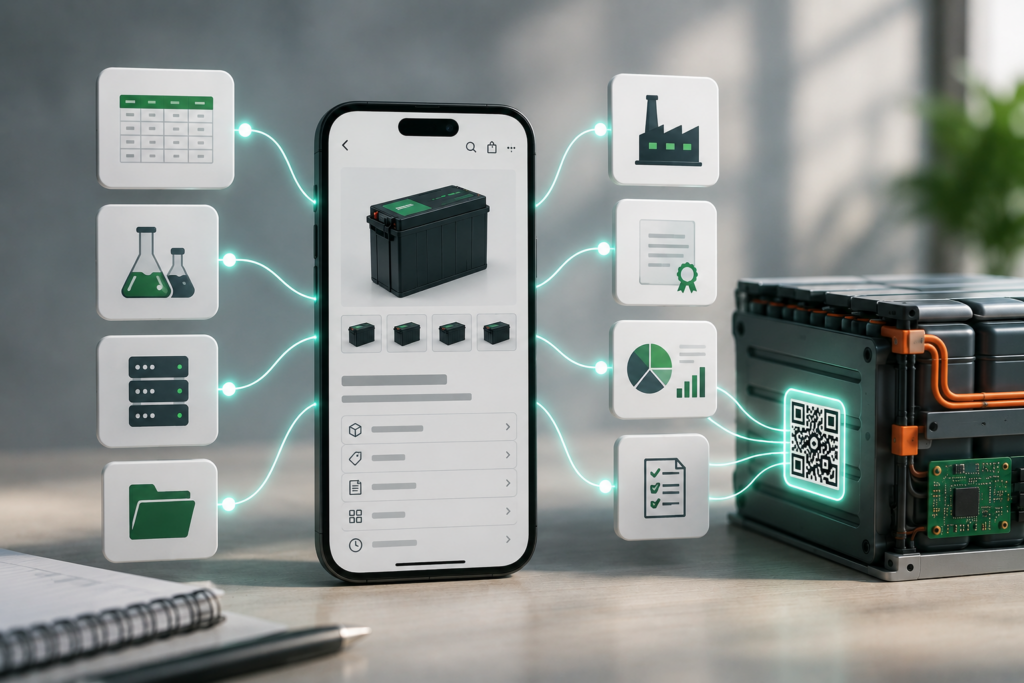
A normal Shopify product page may contain:
- Product title
- SKU
- Description
- Images
- Variants
- Specifications
- Inventory information
But Battery Passport information can go much deeper.
Relevant data may exist in supplier files, laboratory reports, ERP systems, sustainability records, manufacturing databases, and spreadsheets.
This creates a data-management problem before it becomes a QR-code problem.
A Shopify brand needs to know:
- Which battery does this data belong to?
- Who supplied the data?
- Is it current?
- Which product variant does it cover?
- Who can access it?
- What happens when the battery changes?
A structured Shopify Digital Product Passport for Batteries can help connect these information points with the products already managed in Shopify.
A Different Way to Look at the 2027 Timeline
Instead of waiting for the deadline, Shopify brands can divide preparation into three phases.
Phase 1: Now — Build the Data Foundation
Start by identifying all battery products sold in the EU.
Then map:
- Product and battery models
- SKUs and variants
- Suppliers
- Technical information
- Sustainability information
- Existing test reports
- Missing data
The European Commission has already published updated Battery Passport guidance to help businesses understand the required data points.
Phase 2: Before February 2027 — Build and Test
Once the data is available, businesses can establish their DPP workflow.
This includes:
- Creating digital battery records
- Connecting identifiers
- Setting access permissions
- Generating QR codes
- Connecting physical batteries with their digital records
- Testing mobile access
- Checking product-data accuracy
- Testing Shopify or other system integrations
The EU’s DPP Registry became operational on 20 July 2026, together with a testing environment, giving businesses an additional resource while preparing.
Phase 3: From 18 February 2027 — Maintain
Compliance does not stop when the first passport goes live.
Businesses should maintain accurate information and have processes for:
- Product changes
- Supplier changes
- Data corrections
- Lifecycle updates
- Identifier management
- Access control
The regulation requires information accessed through the QR code to be complete, up to date, and accurate.
What Could Battery Passport Compliance Cost?
There is no single EU price for creating a Battery Passport.
The final cost depends on the business.
A small Shopify catalogue with well-organised supplier data may require less work than a large catalogue with thousands of battery products and fragmented supply-chain information.
Typical cost areas include:
Data collection → Data validation → DPP software → Integration → QR implementation → Testing → Ongoing maintenance
The biggest expense may actually be internal data preparation.
If battery information is incomplete or stored in different systems, businesses may need additional time to collect and verify it before creating passports.
How PassoNext Can Support Shopify Battery DPP Workflows
For Shopify merchants, managing a large number of digital passports manually can quickly become difficult.
PassoNext provides a Shopify-focused approach to Digital Product Passport workflows, helping merchants organise product information and connect it with digital passport records.
A Shopify DPP for Batteries can create a workflow such as:
Shopify Product → Battery Model → Product Data → Digital Passport → QR Code
This gives merchants a structured way to manage battery information instead of creating disconnected passport pages manually.
It can also provide a foundation for Shopify brands preparing for future EU DPP requirements beyond batteries.
Battery Passport Preparation Checklist
Before February 2027, Shopify battery sellers should ask:
- Have we identified every in-scope battery?
- Have we confirmed our legal role?
- Do we know which data points apply to our battery category?
- Is our supplier information complete?
- Can every data point be linked to the correct battery?
- Are technical and sustainability records up to date?
- Do we have a DPP solution?
- Can our QR code connect to the correct passport?
- Have we tested the complete customer and stakeholder journey?
- Do we have a process for updating passport information?
Frequently Asked Questions
When does the EU Digital Product Passport for Batteries become mandatory?
The Battery Passport becomes mandatory on 18 February 2027 for each in-scope EV battery, LMT battery, and industrial battery above 2 kWh placed on the EU market or put into service.
Does every battery need a Digital Product Passport?
No. The mandatory Battery Passport requirement applies to the battery categories covered by Article 77, including EV batteries, LMT batteries, and industrial batteries above 2 kWh.
Does an EV Battery Passport require a QR code?
Yes. From 18 February 2027, the Batteries Regulation requires the relevant batteries to carry a QR code that provides access to the Battery Passport.
Can Shopify provide a Battery Passport?
Shopify can hold and manage product information, but businesses need an appropriate DPP workflow to meet the specific Battery Passport requirements. A Shopify-integrated solution can connect store product data with digital passport information.
What is Shopify Digital Product Passport for EV Batteries?
It is a DPP workflow that connects EV battery product information managed through Shopify with a digital battery record, allowing the relevant product information to be organised and connected to the physical battery.
How much does an EU Battery Passport cost?
There is no fixed EU fee. Costs depend on the number of batteries, data quality, software, integrations, verification, physical QR implementation, and ongoing maintenance.
Final Thoughts
The EU Digital Product Passport for Batteries is not simply a new QR-code requirement.
It represents a new way of managing battery information across the product lifecycle.
For Shopify brands, the most important preparation is to get the data organised before the technology is switched on.
Start with the product.
Connect the right data.
Create the digital record.
Link it to the physical battery.
Then maintain it.
With the 18 February 2027 deadline approaching, 2026 is the right time for Shopify battery sellers to identify data gaps, work with suppliers, test their DPP workflow, and prepare their products for the EU market.
For merchants looking for a Shopify-focused approach, PassoNext can help build the product-data foundation needed for a structured Digital Product Passport workflow.
Get ESPR-ready today
The 2027 deadlines are closer than they look. Start building your DPP infrastructure now — not six months before the deadline. PassoNext is free to install.
