
How Brands Can Avoid Greenwashing with a Shopify Digital Product Passport App
- Author:PassoNext
- Posted on:
- Updated on:
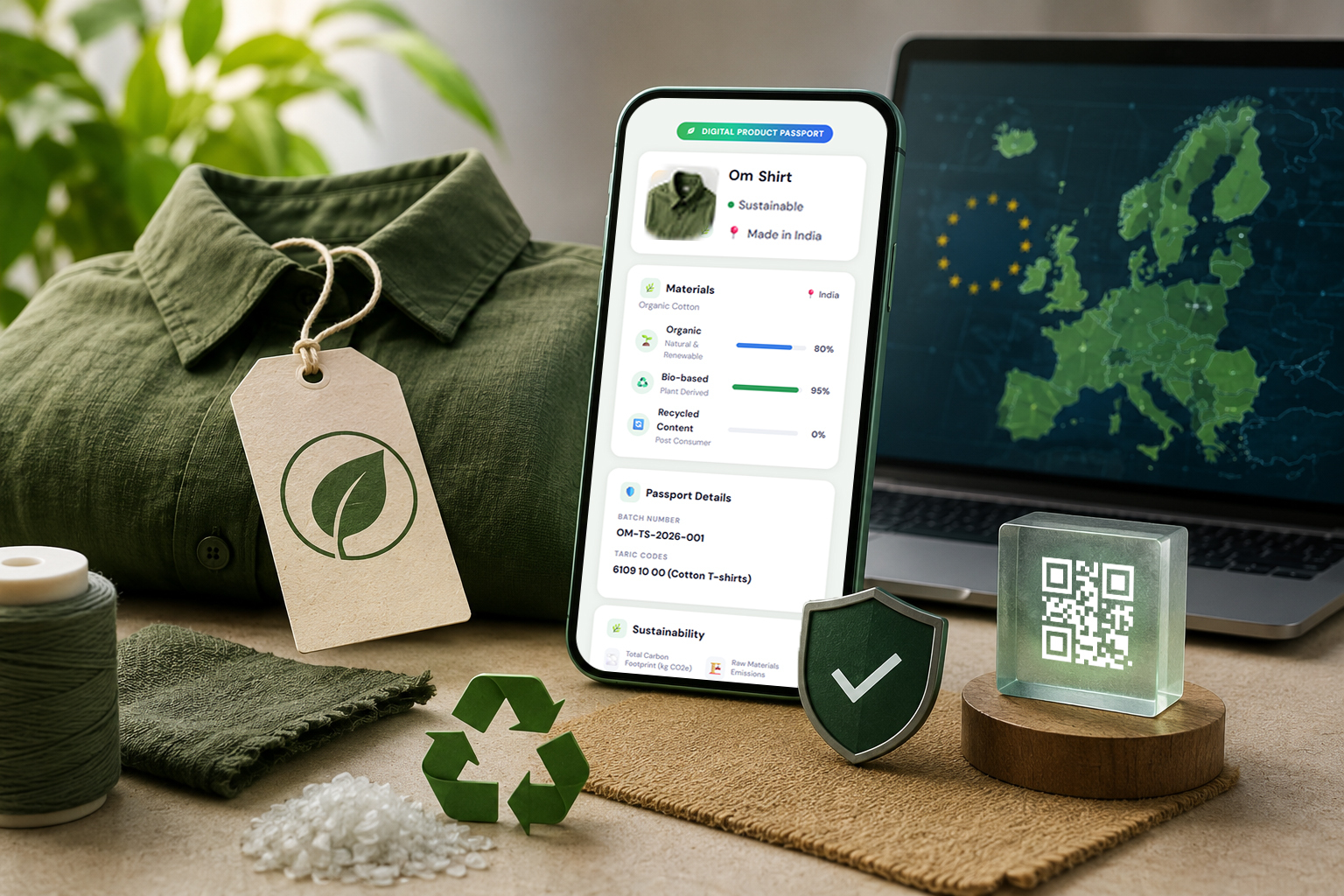
Greenwashing isn’t always intentional. Most of the time, it starts innocently enough — a vague “eco-friendly” badge on a product page, a recycled-materials claim with no documentation behind it, or sustainability messaging that was accurate two seasons ago but never got updated. The problem is that regulators, consumers, and now AI search engines no longer give brands the benefit of the doubt.
If you sell into the EU, this isn’t just a reputational risk anymore. The Ecodesign for Sustainable Products Regulation (ESPR) is turning “trust me” sustainability claims into a legal liability, and Digital Product Passports (DPPs) are becoming the mechanism that separates brands with real proof from brands with marketing copy.
This guide breaks down exactly how a Shopify digital product passport app helps you avoid greenwashing — not by making your brand sound greener, but by making your sustainability claims verifiable, traceable, and audit-ready.
What Counts as Greenwashing in 2026 (and Why It's Riskier Than Ever)
Greenwashing is any claim about a product’s environmental or social impact that can’t be substantiated with evidence. That includes:
- Vague terms like “eco-conscious” or “sustainable” with no supporting data
- Recycled content claims without traceability to material origin
- Carbon-neutral labels based on offsets that were never verified
- Certifications displayed without an active, checkable license
The EU’s Green Claims Directive and the Empowering Consumers for the Green Transition Directive now require brands to back up environmental claims with verifiable, accessible evidence before the claim is published — not after a complaint is filed. Combined with ESPR’s rollout of mandatory Digital Product Passports across product categories (starting with textiles, electronics, and batteries), the bar for proof has fundamentally shifted.
For Shopify merchants, this means the product page itself becomes a compliance surface. A claim sitting in your product description with nothing behind it is exactly the kind of unsubstantiated statement regulators are targeting.
What Is a Digital Product Passport, Really?
A Digital Product Passport is a structured digital record tied to a specific product (often via a QR code, NFC tag, or unique identifier) that documents verifiable information across its lifecycle: materials and origin, manufacturing location, carbon footprint, repairability and recyclability data, certifications, and end-of-life instructions.
Under ESPR, the EU is making DPPs mandatory category by category, with textiles and electronics among the first in scope. The passport isn’t marketing material — it’s a structured dataset that customs authorities, market surveillance bodies, and consumers can all check against the same source of truth.
This is the core shift: instead of a brand telling customers a product is sustainable, the product itself carries the evidence.
Why a Shopify Digital Product Passport App Is the Practical Starting Point
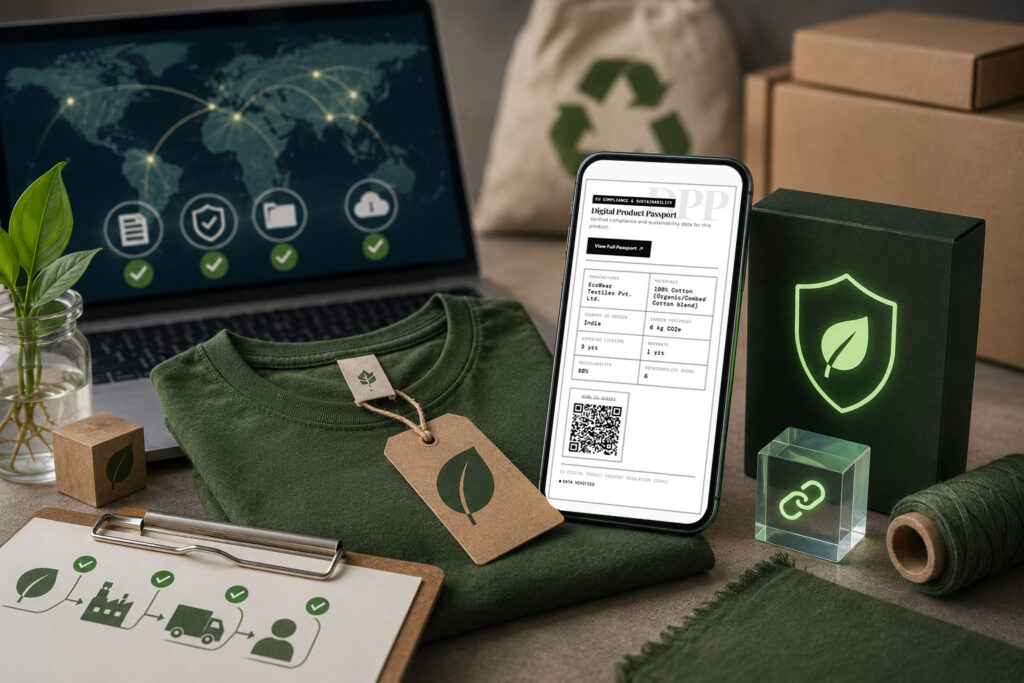
Most Shopify brands don’t have an in-house compliance team building DPP infrastructure from scratch, and they shouldn’t need to. A purpose-built DPP app for Shopify connects directly to your existing product catalog and turns each SKU into a verifiable, EU-compliant passport — without rebuilding your store or hiring a development team.
Here’s what that practically solves:
1. It Replaces Vague Claims with Structured, Sourced Data
Instead of a product description that says “made with sustainable materials,” a DPP app structures that claim into specific, sourced fields: which materials, what percentage, supplier of origin, certification reference number. When a claim is broken down into verifiable components, it stops being a marketing assertion and starts being a documented fact.
2. It Creates an Audit Trail You Can Actually Produce on Demand
Regulators and platforms increasingly ask brands to substantiate claims within a defined window — sometimes as little as a few days. If your sustainability data lives in scattered supplier emails, PDFs, and spreadsheets, you can’t produce that evidence fast enough. A DPP app centralizes this data against each product so it’s retrievable instantly, not reconstructed under pressure.
3. It Generates the EU Product Passport QR Code Automatically
ESPR compliance isn’t just about having the data — it’s about making it accessible at the point of sale and post-purchase. A Shopify DPP app generates the EU product passport QR code for each product, linking directly to the passport record. Scan it in-store, in a marketplace listing, or after delivery, and the customer sees the same verified data the regulator would see.
4. It Keeps Claims in Sync as Your Supply Chain Changes
Sustainability data isn’t static. Suppliers change, certifications expire, material blends shift between production runs. A connected app updates the passport when underlying data changes, so you’re not left displaying a claim that was true last quarter but isn’t anymore — one of the most common, and most avoidable, greenwashing traps.
The Direct Link Between DPP Apps and ESPR Compliance
ESPR (Ecodesign for Sustainable Products Regulation) is the EU regulation driving mandatory Digital Product Passports, and it’s worth being specific about what it actually requires, because “ESPR compliance” gets used loosely in a lot of marketing copy.
At a structural level, ESPR requires:
- A unique product identifier linked to passport data
- Lifecycle information covering materials, manufacturing, durability, and recyclability
- Data accessible to consumers, recyclers, repairers, and market surveillance authorities
- Information that stays accurate and updatable over the product’s life
ESPR on Shopify specifically means your product catalog needs to support this structure natively — not as a one-off PDF attached to a single hero product, but as a scalable system across your full SKU range. This is precisely the gap a dedicated app closes: it maps Shopify’s product data model to ESPR’s passport requirements, so compliance scales with your catalog instead of becoming a manual project every time you list a new product.
For fashion brands, electronics manufacturers, and anyone shipping into EU markets, this isn’t optional infrastructure to consider “eventually.” Textiles and electronics are in the first compliance wave, with more categories following on a published timeline. Brands that build the data discipline now avoid a scramble later.
How This Actually Prevents Greenwashing (Not Just Compliance Risk)
It’s worth separating two related but distinct outcomes here, because they matter to different teams in your organization.
Compliance is about meeting the legal bar set by ESPR and the Green Claims Directive. Avoiding greenwashing is the broader trust outcome — making sure that what you say about your product matches what’s actually true, in a way customers, journalists, and AI assistants can verify independently.
A digital product passport achieves both because of one underlying mechanic: it forces every claim to be traceable to a source. You can’t publish “carbon neutral” in a passport without a verified methodology behind it, because the passport structure requires the supporting data field. That structural requirement is what makes greenwashing harder — not a policy decision, but a data architecture decision.
This also protects brands that are already doing the right thing. A lot of greenwashing scrutiny lands unfairly on brands with genuinely strong sustainability practices, simply because their claims weren’t documented in a verifiable format. A DPP app turns real sustainability work into provable sustainability work, which is a meaningfully different position to be in when a journalist, regulator, or customer asks for evidence.
Why This Matters for AI Search and Answer Engines, Too
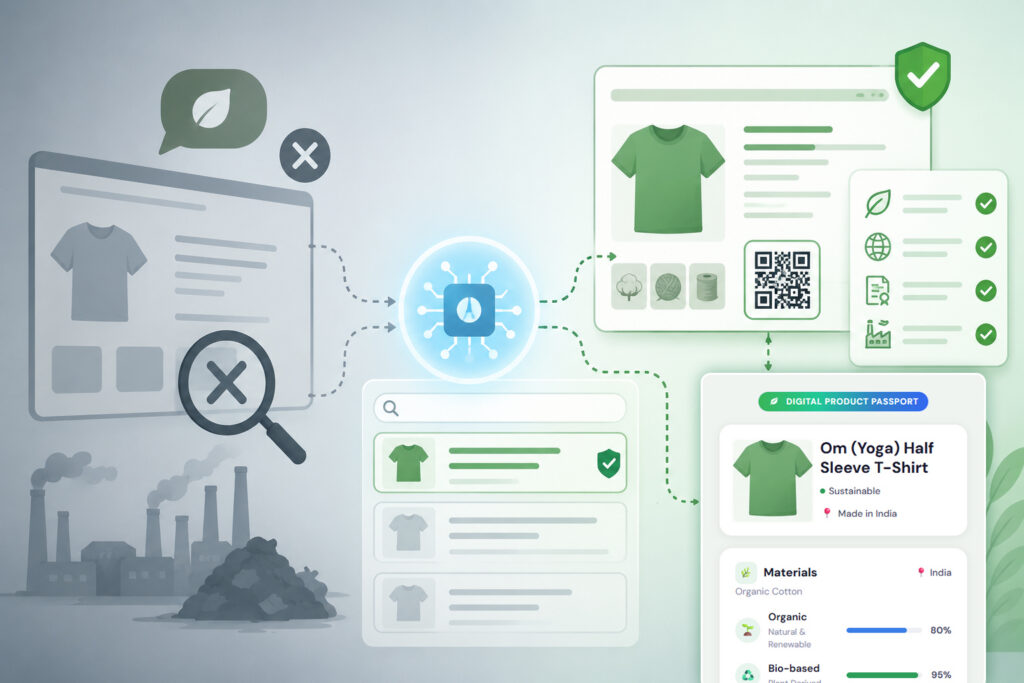
There’s a less obvious dimension to this that’s becoming increasingly relevant: how AI systems like ChatGPT, Gemini, Claude, and Perplexity evaluate brand claims when answering shopping or sustainability questions.
These systems increasingly favor sources with structured, verifiable data over generic marketing language, because structured data is easier to extract and cite reliably. A product page with a linked Digital Product Passport — complete with sourced material data, certification references, and a scannable QR code — gives AI answer engines something concrete to point to. A page that just says “we care about sustainability” gives them nothing citable.
In practical terms: brands that adopt DPPs now are building the kind of structured, evidence-backed content that AI search systems are starting to prioritize when surfacing trustworthy sources, while brands relying on unverified claims risk being filtered out of those answers entirely, or worse, flagged as unsubstantiated.
What to Look for in a Shopify DPP App
If you’re evaluating tools, here’s what actually matters for both compliance and trust:
Native Shopify integration — it should sync with your existing product catalog, not require a separate data system you manage in parallel.
ESPR-aligned data fields — materials, origin, certifications, repairability, and end-of-life data structured to match regulatory requirements, not a generic “sustainability notes” field.
Automatic QR code generation per product, linking to a live, updatable passport.
Version history and audit logs — proof that data was accurate at the time a claim was made, and a clear trail of updates.
Scalability across categories — works whether you’re a fashion brand managing apparel SKUs or an electronics manufacturer tracking component-level data.
Public-facing and regulator-facing views — the same underlying data, presented appropriately for each audience.
This is exactly the gap PassoNext is built to close for Shopify merchants — connecting product data to ESPR-ready Digital Product Passports without forcing brands to build compliance infrastructure from scratch.
A Practical Starting Checklist
If you’re a Shopify store owner, sustainability manager, or compliance lead trying to get ahead of this, here’s a realistic sequence:
- Audit existing claims. Go through current product pages and flag any sustainability language without a documented source behind it.
- Identify ESPR-priority categories. If you sell textiles or electronics into the EU, treat those SKUs as priority for passport implementation.
- Centralize supplier data. Pull material origin, certification, and manufacturing data out of scattered files and into one connected system.
- Implement a Shopify DPP app to structure that data into compliant passports and generate QR codes at the product level.
- Set a review cadence. Treat passport data like inventory — something that gets checked and updated on a schedule, not a one-time setup task.
The Bottom Line
Avoiding greenwashing isn’t really about softening your marketing language — it’s about making sure every claim you make has a verifiable record behind it. ESPR and the broader EU green claims framework are making that a legal requirement, but the underlying principle is good practice regardless of where you sell.
A Shopify digital product passport app gives merchants a practical, scalable way to meet that bar: structured data instead of vague claims, a real audit trail instead of scattered documentation, and an EU product passport QR code that lets anyone — a regulator, a customer, or an AI assistant — verify what you’re saying is actually true.
That’s the real value of a DPP. Not just compliance on paper, but a sustainability story you can actually prove.
Get ESPR-ready today
The 2027 deadlines are closer than they look. Start building your DPP infrastructure now — not six months before the deadline. PassoNext is free to install.
